
The list below follows Caravan’s own production record of original plays as well as known plays, plus a handful of pieces — short “happenings,” revues, and touring children’s shows. Where a show toured or was revived, the run is noted.
American Friends Service Committee Summers
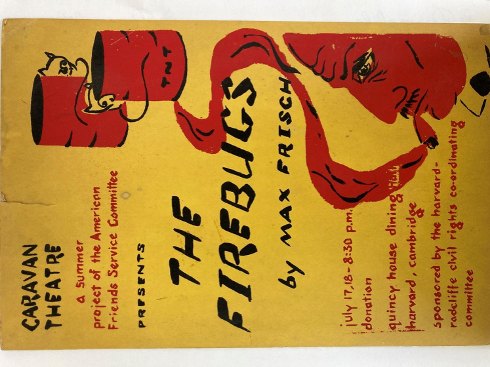
THE FIREBUGS by Max Frisch
Directed by Bobbi Ausubel
CAST: Summer ensemble
1965 summer project, sponsored by American Friends Service Committee (AFSC)
Bus tour throughout New England
Two sneaky male “firebugs” (people who deliberately set destructive fires) enter a house and store ammunition in its attic. This causes a fire and burns the house down. The play is an analogy commenting on U.S. and other countries storing nuclear armaments, which was a major news topic at the time.
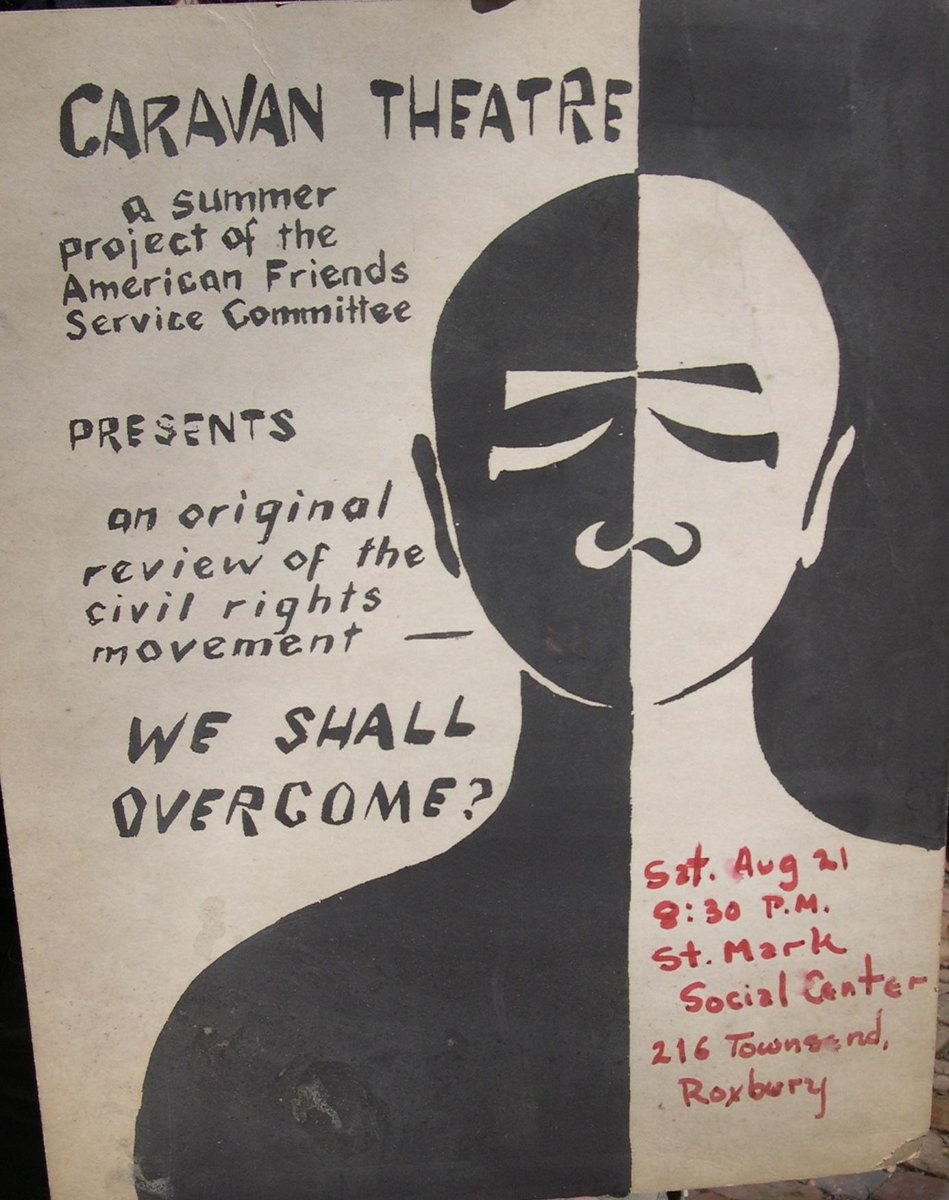
WE SHALL OVERCOME?
A company-created play (ensemble of young Black and white actors)
Directed by Stan Edelson
CAST: Summer ensemble
1965 summer project, sponsored by the American Friends Service Committee (AFSC)
Bus tour throughout New England
Several short scenes depicting relationships between Black people and white people.
PAUSE AND BEGIN AGAIN by Stan Edelson
Directed by Stan Edelson
February 1966
Rose Coffee House, North End, Boston
A topical revue of poetry, song and humor, inspired by the phrase “Make Love, Not War.”
ARIA DA CAPO by Edna St. Vincent Millay & HAPPY DAYS by Samuel Beckett
Directed by Stan Edelson
1966 May
CAST: Boston’s cabaret players
Harvard Epworth Methodist Church, Cambridge
In a pop-art setting with original music.
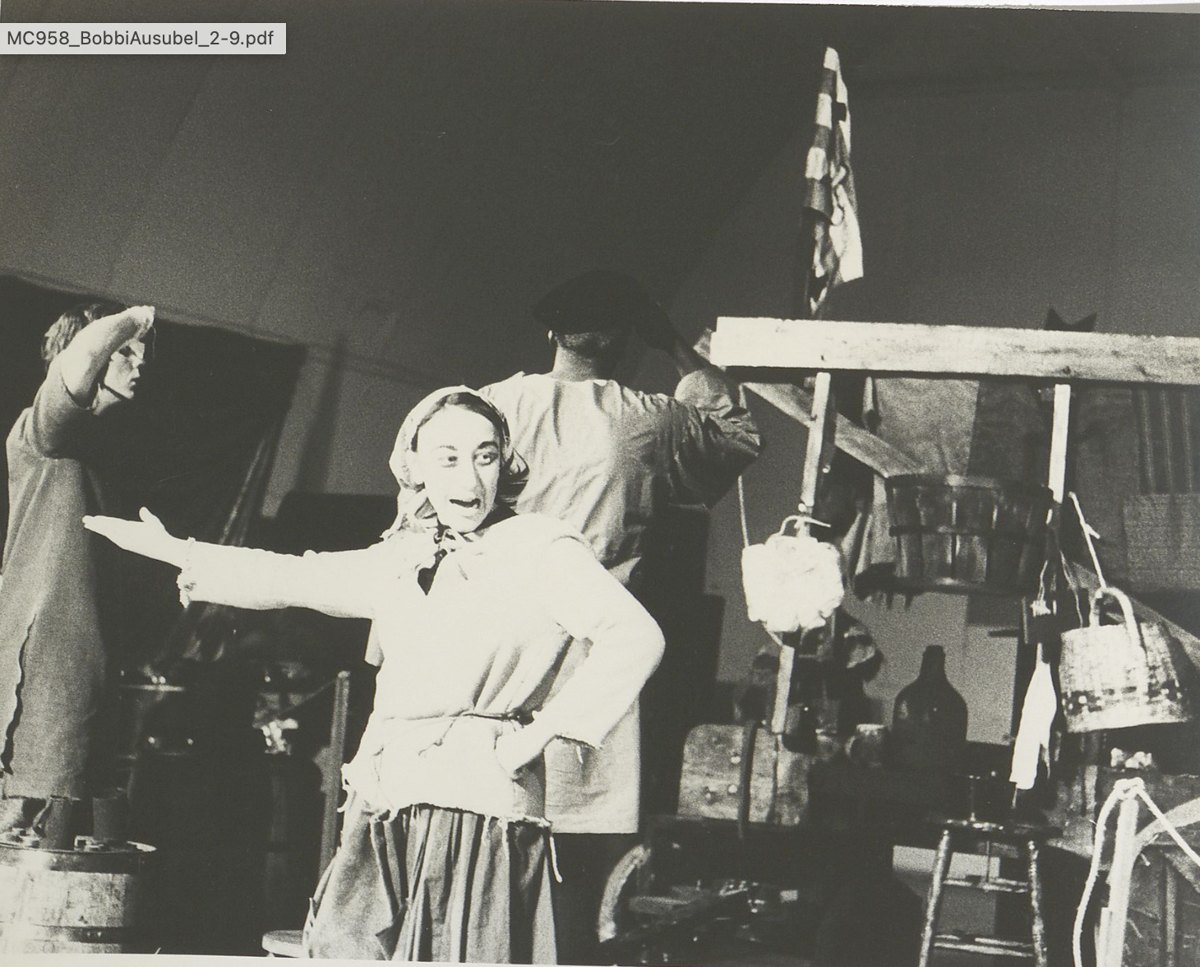
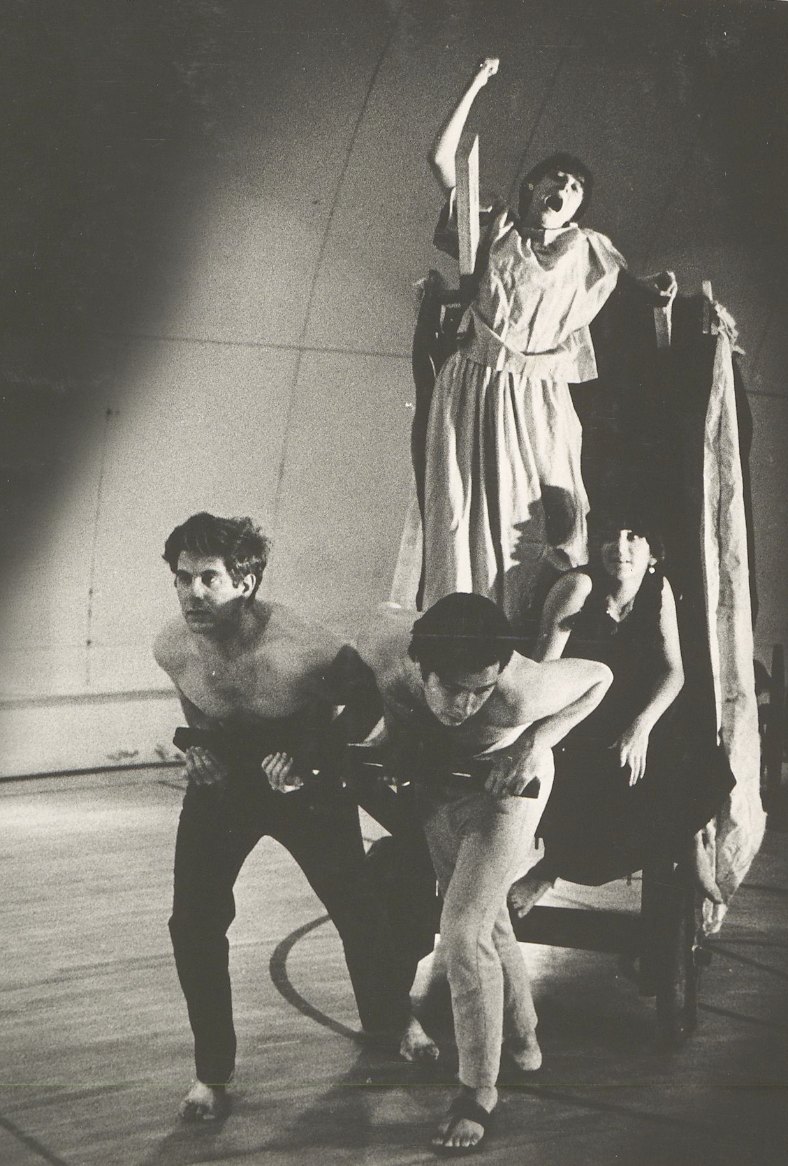
MOTHER COURAGE by Bertolt Brecht
Directed by Bobbi Ausubel
CAST: Barbara MacKenzie-Wood as Katrin and summer ensemble
1966 summer project, sponsored by the American Friends Service Committee (AFSC)
Bus tour around New England, including Harvard Epworth Methodist Church, Cambridge, MA
An anti-war play performed during the Vietnam war. A well-known Brecht play in which the main character, Mother Courage, enters a war zone to sell wares from her wagon to the soldiers in order to make money. Because of the war, both of her sons die and her daughter is injured.
A home in Harvard Square
HOW TO MAKE A WOMAN by Stan Edelson
(see: tab How To Make A Woman for full description)
Conceived and directed by Bobbi Ausubel
1967 Passims Coffee House/Club 47
CAST: (Original) Mary Rosenblum, Aili Singer, Fay Hiken, Chris Groden, David Baker, Joe Volpe
CAST; 1969 Barbara MacKenzie-Wood, Aili Singer, Joe Volpe, Robert Bridges & Anne Barclay Priest.
CAST: 1969–1972 Cast: Barbara MacKenzie-Wood, Aili Singer, Joe Volpe, David Starr Klein, Anne Barclay Priest, Pete Kovner
Ran intermittently from 1967–1972, first at Club 47 and then Harvard Epworth Church, Cambridge, MA.
A social commentary on gender roles and relations. See webpage on How to Make a Woman. This play was the most consequential work of Caravan’s existence.
EXPERIMENTAL HAPPENING by Stan Edelson
Conceived and directed by Stan Edelson
January 1967
Club 47 and Harvard Epworth Methodist Church, Cambridge, MA
Artistic and experimental event
BADEN LEHSTRUCK (BADEN LESSON-PIECE) by Bertolt Brecht
Adapted & directed by Stan Edelson
CAST: Steve Burdett, John Graff, Jim Hayes, Patricia Collins & Judith Epstein
1967 February
Harvard-Epworth Church, Cambridge, MA
A pageant and learning piece using symbolic figures as a parable of pride and renunciation, showing the need for personal humility in the face of the world’s harsh realities. Adapted using a chorus of two clowns
IT’S LIKE A… by Stan Edelson
Conceived and directed by Stan Edelson
February 1967
Club 47, Cambridge, MA, and Winterfest at War Memorial Auditorium, Boston
A “Happening” with audience participation
MONEY TALKS / AN EVENING OF BRECHT / MIXED MEDIA / THEATER OF CRUELTY
Conceived and directed by Stan Edelson
Summer 1967
Various short shows.
THE MAIDS by Jean Genet
Directed by Bobbi Ausubel
August 1967
CAST: Carol Berman, Judith Epstein
Two lower class maids struggle as they clean a house. Their struggles are depicted in abstract movements. They live through fantasies, mostly spiritual. At the end of the play, the doors to the real church’s sanctuary were opened and the maids walked slowly to their God toward the church altar. Boston Globe review called this “Near genius”.
A HALLOWEEN HAPPENING
Directed by Bobbi Ausubel and Stan Edelson
October 1967
At Cambridge Center for Adult Education
Audience were told in advance to come in costume, or in old, “dispensable” clothes and accessories.
THE MEASURES TAKEN by Bertolt Brecht
Directed by Stan Edelson
CAST: 1967: Patricia Collins, Judith Epstein, Steve Burdett, John Graff, Jim Hayes
1968: Gary Steffens, Peter Lago, Nancy Williams, James Selis
December 1967 and February 1968
Brecht’s classic play in which four comrades relay their story to a tribunal court: For the sake of fulfilling a mission, a comrade was killed.
HOW PROMETHEUS GOT BOUND A clown play by Stan Edelson
Directed by Bobbi Ausubel
CAST: Susan Hanley, Gary Steffens, John Graff, Fern Merle
October 1968
Interact, a Brandeis University International Theater Festival, and Harvard Epworth Methodist Church, a grange in Maine
A clown satire based on the story of Prometheus.
IPHIGENIA IN AULIS by Euripides, translated by Kenneth Cavender
Directed by Bobbi Ausubel
CAST: Peter Lago, Bill Robinson, Gary Steffens, Margaret Harrington, Linda Arnswalder, Rosaria Sorbello.
November 1968 through February 1969
Euripides’ classic anti-war play done as a statement against the Vietnam war. The play was told as a ritual in which male Greek war leaders carried puppet heads atop very long poles.
ANY COW WILL DO by Stan Edelson
Directed by Stan Edelson
CAST: Robert Bennett, Karen Golden, Bill Robinson
February 1969
An original fantasy with mime, dance and song.
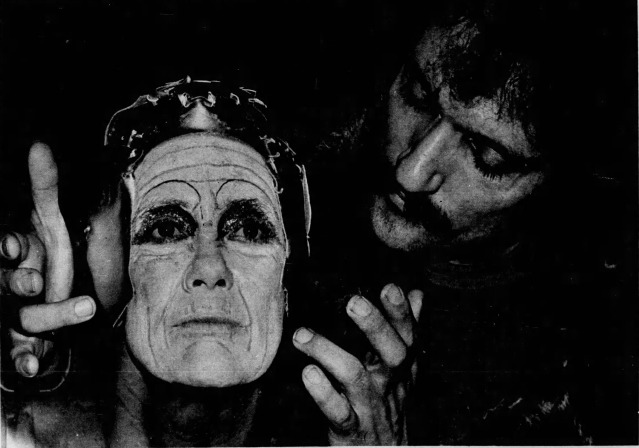
Continuing to Evolve
HOW TO MAKE A WOMAN by Stan Edelson
Conceived, directed and revised by Bobbi Ausubel
1967 CAST: (Original) Mary Rosenblum, Leilani Johnson, Aili Singer, Fay Hiken -Mannequin; Joel Polensky, Sara Screech, Chris Gordon/Groden, Joe Volpe
1969 CAST: Barbara MacKenzie-Wood, Aili Singer, Joe Volpe, Robert Bridges, David Baker & Anne Barclay Priest.
1969–1972 CAST: Barbara MacKenzie-Wood, Aili Singer, Joe Volpe, David Starr Klein, Anne Barclay Priest, Pete Kovner
Ran intermittently from 1967–1972
Harvard-Epworth Church, Touring New England colleges, Alternate U., NYC and Festival of Festivals Wroclaw, Poland.
A social commentary on the construction of gender roles and relations. Two women enter a dress shop run by men and are given dresses that represent roles females are expected to play out. This long running play was the most consequential work of Caravan’s existence. See tab page How to Make a Woman.
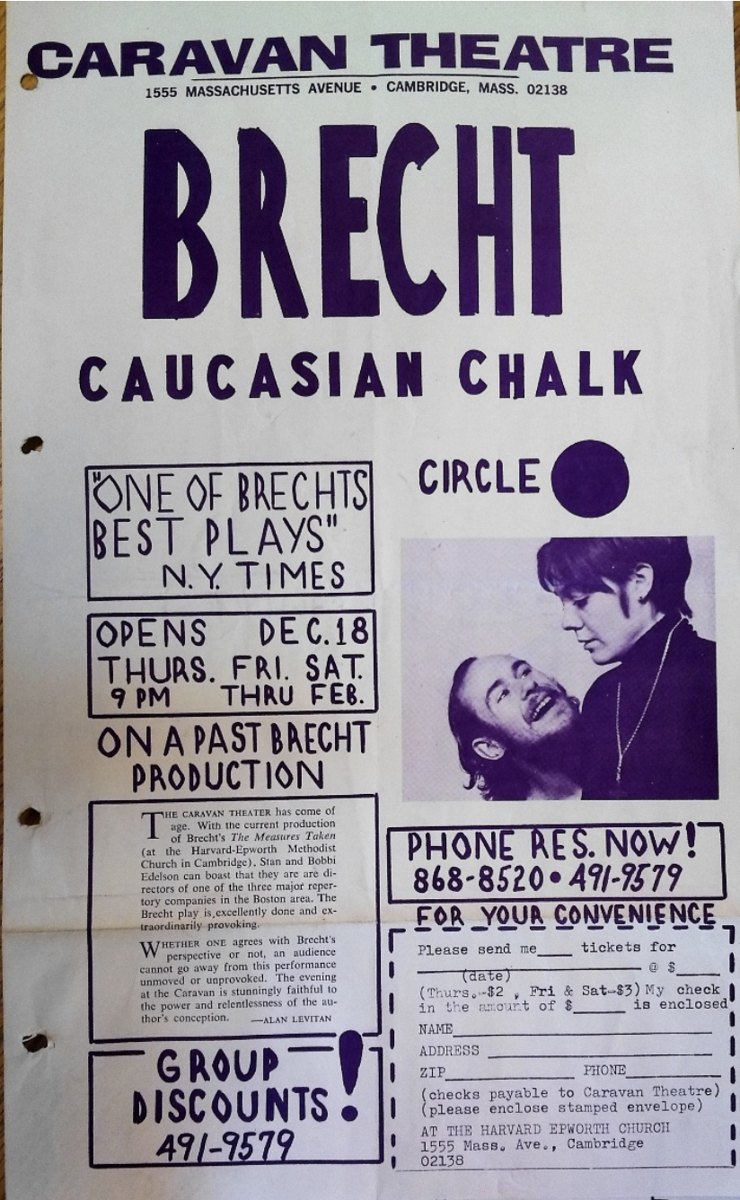
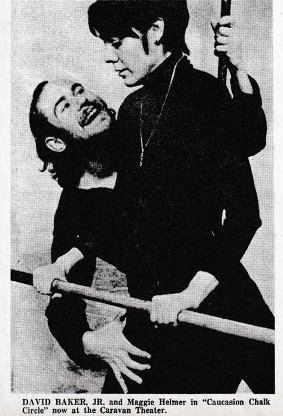
CAUCASIAN CHALK CIRCLE by Bertolt Brecht
Directed by Stan Edelson
December 1969 – March 1970
CAST: (actors played multiple roles) Maggie Santi Helmer/Jehane Dylann, David Starr Klein, David Baker Jr., Bonnie Beatty, Martha Crawford, Harvey Cushing, Richard Green, Margaret Harrington, Allan Present, Leonard Tamulonis
DESCRIPTION by David Klein: “The physical production was extraordinary, with larger-than-life puppets mounted on coat racks on wheels for the aristocrats. Only the “lower classes” were real people. That was the first statement about social class and a perfect fit for Brecht. Stan, with fellow artist Arnold Trachtman, painted backdrops for each scene, in black paint, on a huge piece of 6 foot cloth. Each scene took up about 10 feet of the cloth, which was then stitched together so it was at least 70 feet long. It was mounted on 2 huge spools, one on each side of the rear of the stage. When the scene changed, the rollers were turned by the actors until the next scene appeared. These were huge technical and artistic achievements for a small theater with no money, but Stan pulled it off.
Stan found a theatrically effective format for the play, dividing the narration up among the whole cast rather than having a narrator off to the side. The narration was delivered by the actors entering the new scene, as they changed the minimal scenery and props on the stage, and while the backdrop spools were turned by other actors. Much more interesting than a single narrator.
“Stan eliminated the opening scene of the script which took place on a collective farm (who cared about collective farms in 1969 Boston?) and instead had the actors come out and do warmup exercises for about 10 minutes while the audience was taking their seats.
It was an epic show – and also sold very well. We ran for months to full houses.
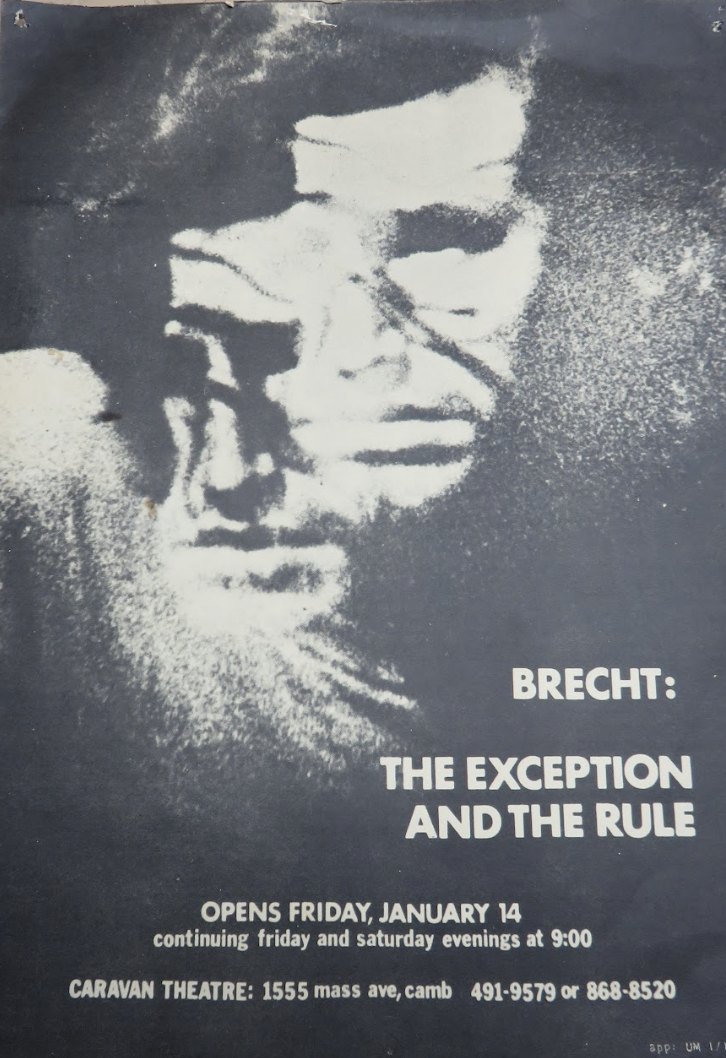
EXCEPTION AND THE RULE by Bertolt Brecht
Directed by David Klein
CAST: Aili Singer, Joe Volpe, Stan Edelson, Pete Kovner
February 1972
A play about class struggle and the impossibility of human kindness under capitalism. A servant offers water to his boss, who assumes the servant wants to kill him, so he kills instead. Is he guilty? No; a judge finds him not guilty.
HANDS OFF! Three one-act plays
ACT WITHOUT WORDS II by Samuel Beckett and Slavomir Mrozek’s STRIP-TEASE
Directed by Aili Singer
CAST: David Starr Klein, Joe Volpe, Kathy Gallucci
CASCANDO by Samel Beckett
Directed by JoAnn Green
April 1972
Three short plays with a common theme of freedom and control.
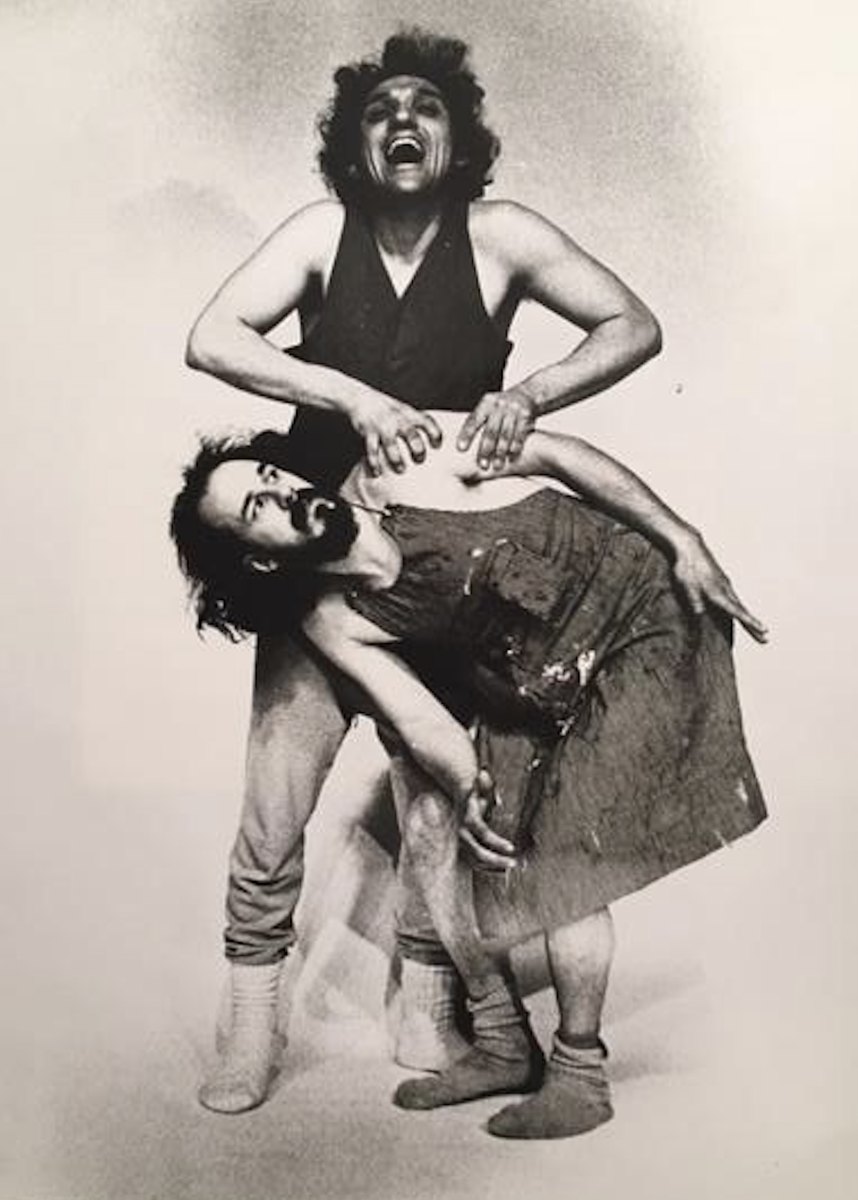
COME CLOSER, YOU’RE SMOTHERING ME by Stan Edelson
Directed by Stan Edelson
CAST: David Starr Klein, Anne Barclay Priest, Pete Kovner, Barbara MacKenzie-Wood
June 1972
Stan created serio-comedic scenes within the narrative of two heterosexual relationships in crisis: a ‘traditional’ older married couple and a young ‘enlightened’ man and woman living together unmarried, and thus beyond bourgeois societal norms. However, neither escapes the conundrum of one partner needing an ever-deepening relationship and the other needing ‘space’ for individual realization, or simply to breathe freely. Both couples split with the hope that finding themselves as individuals might allow them to return whole as a genuine couple.”
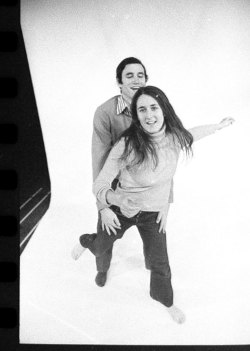
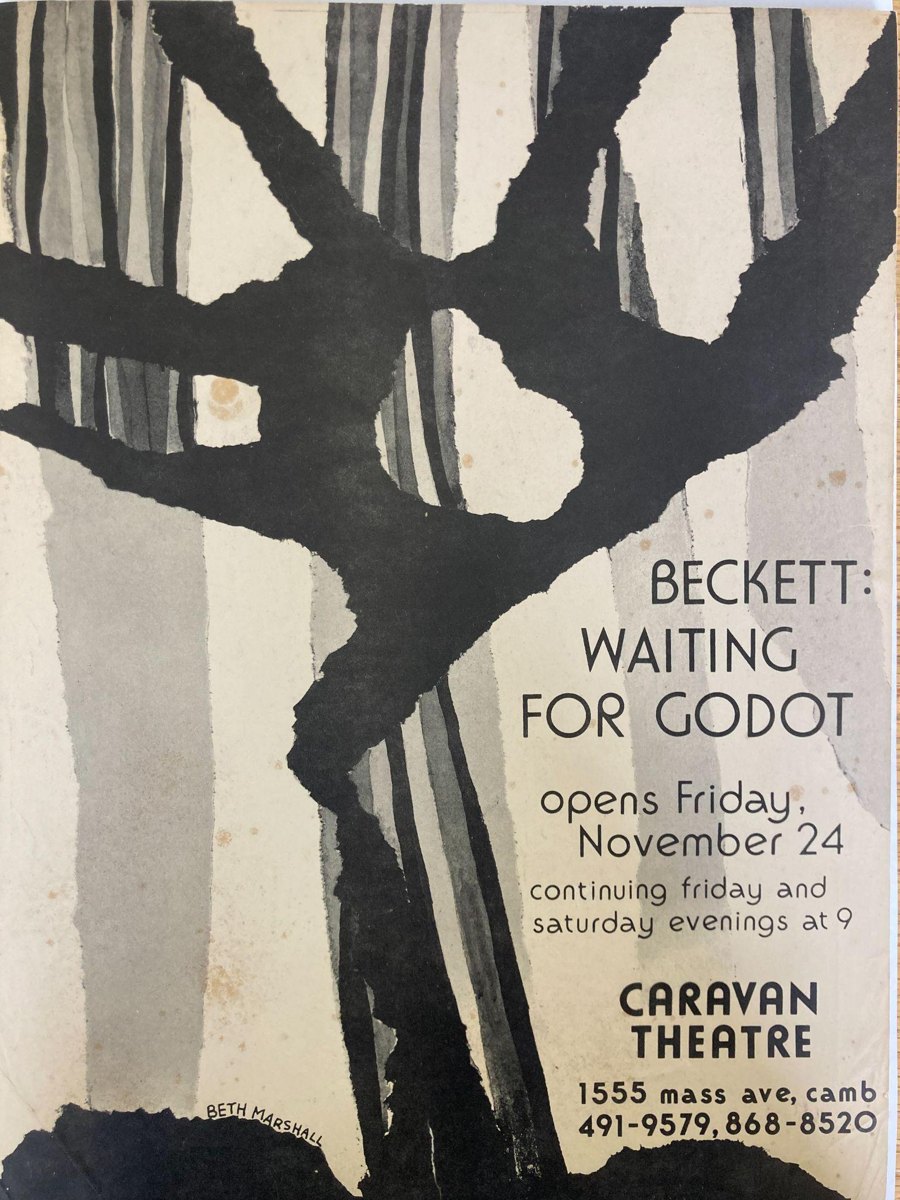
WAITING FOR GODOT by Samuel Beckett
Directed by Bobbi Ausubel
CAST: Peter Kovner, David Starr Klein, Barbara MacKenzie-Wood, Nancy Lovell, Becky
November 1972-March 1973
Beckett’s classic play, but with a twist. This production of the play, which was originally written for four male actors, had a mixed-gender cast. This was revolutionary for its time (though it is commonplace now). Women played Estragon and Lucky, which allowed for an exploration of male-female relationships.
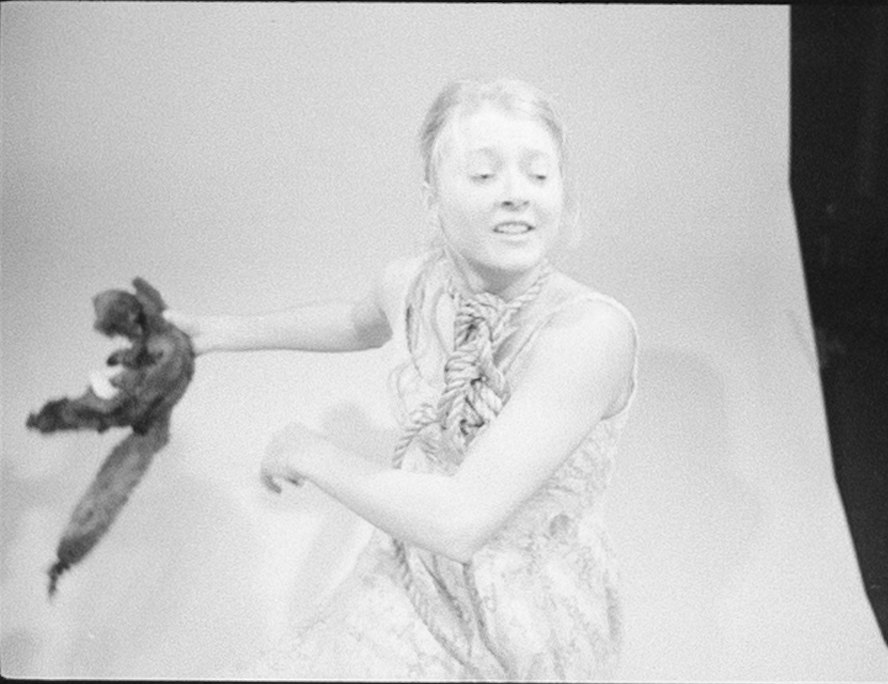
THE JEWISH WIFE by Bertolt Brecht / I CAME INTO THE WORLD by Peter Handke
THE JEWISH WIFE — CAST: Aili Singer, David Starr Klein
I CAME INTO THE WORLD (originally “SELF-ACCUSATION”) by Peter Handke
Both directed by JoAnn Green
CAST: David Starr Klein, Anne Barclay Priest, Pete Kovner, Barbara MacKenzie-Wood
March 1973
The Jewish Wife (a one-act play): Brecht’s play is a monologue of a Jewish woman married to an Aryan man in early 1930’s Germany. She is speaking on the phone, pretending she is leaving for a summer vacation. Yet as she walks out the door, she takes her winter coat, knowing she will never return.
I Came Into the World (a one-act play): A thoroughly avant-garde piece with no plot, in which the actors speak directly to the audience. The characters delight in accusing themselves of various things.
JASON-MEDEA by Stan Edelson
Directed by Bobbi Ausubel
CAST: David Starr Klein, David Baker, Barbara MacKenzie-Wood, Jackie Hooker, Pete Kovner, Mark Burnette, Joe Volpe, Maggie Santi Helmer (aka Jehane Dylann Reuther)
Rehearsals December 1970 – April 1971
Preview: April 1971
The theme is taken from the myth of Jason’s search for the Golden Fleece. The play depicted the struggle of men and women to overcome their gender issues and live together equally. Abandoned before any further performances.
On the boards
The personal turn
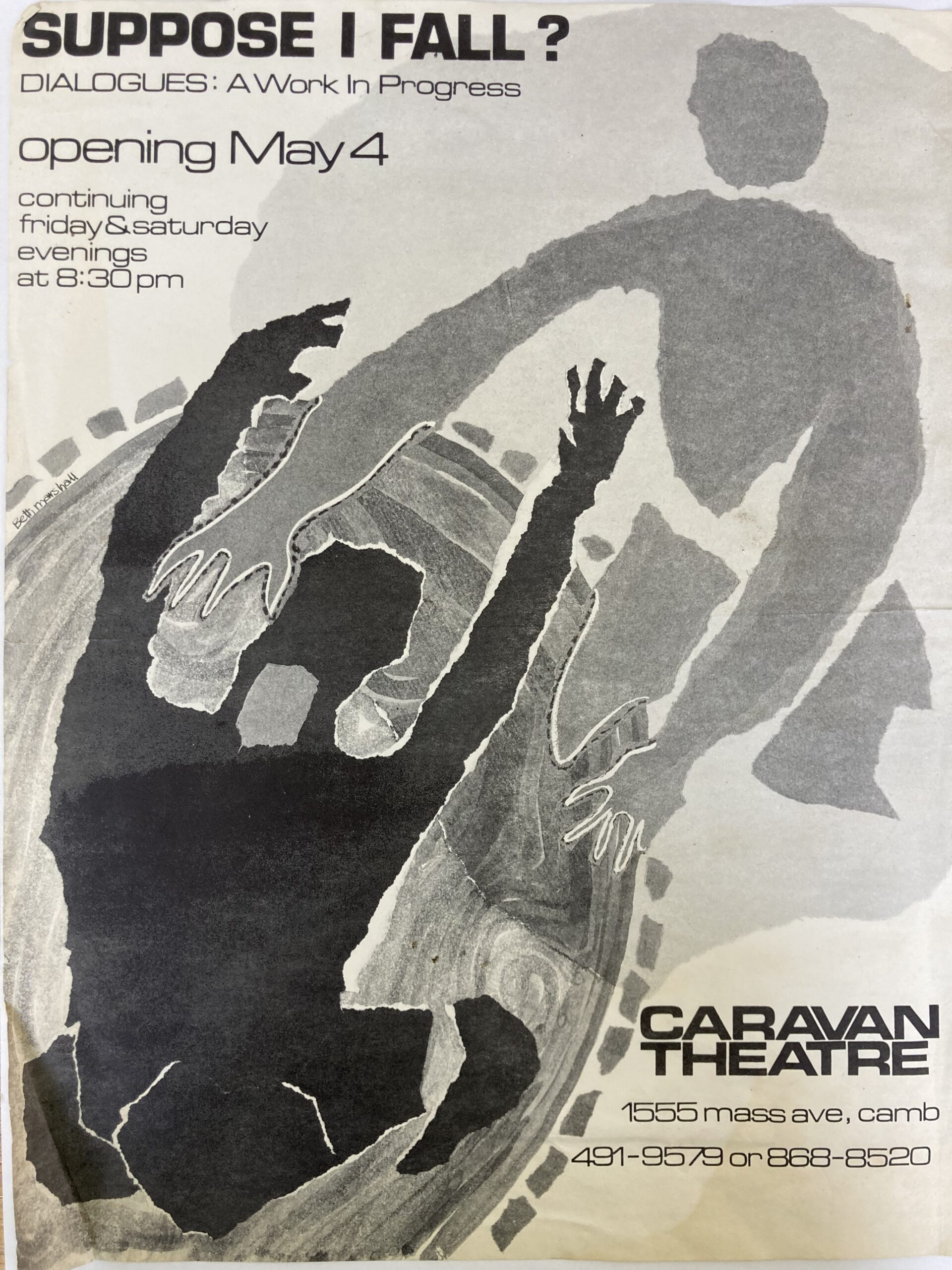
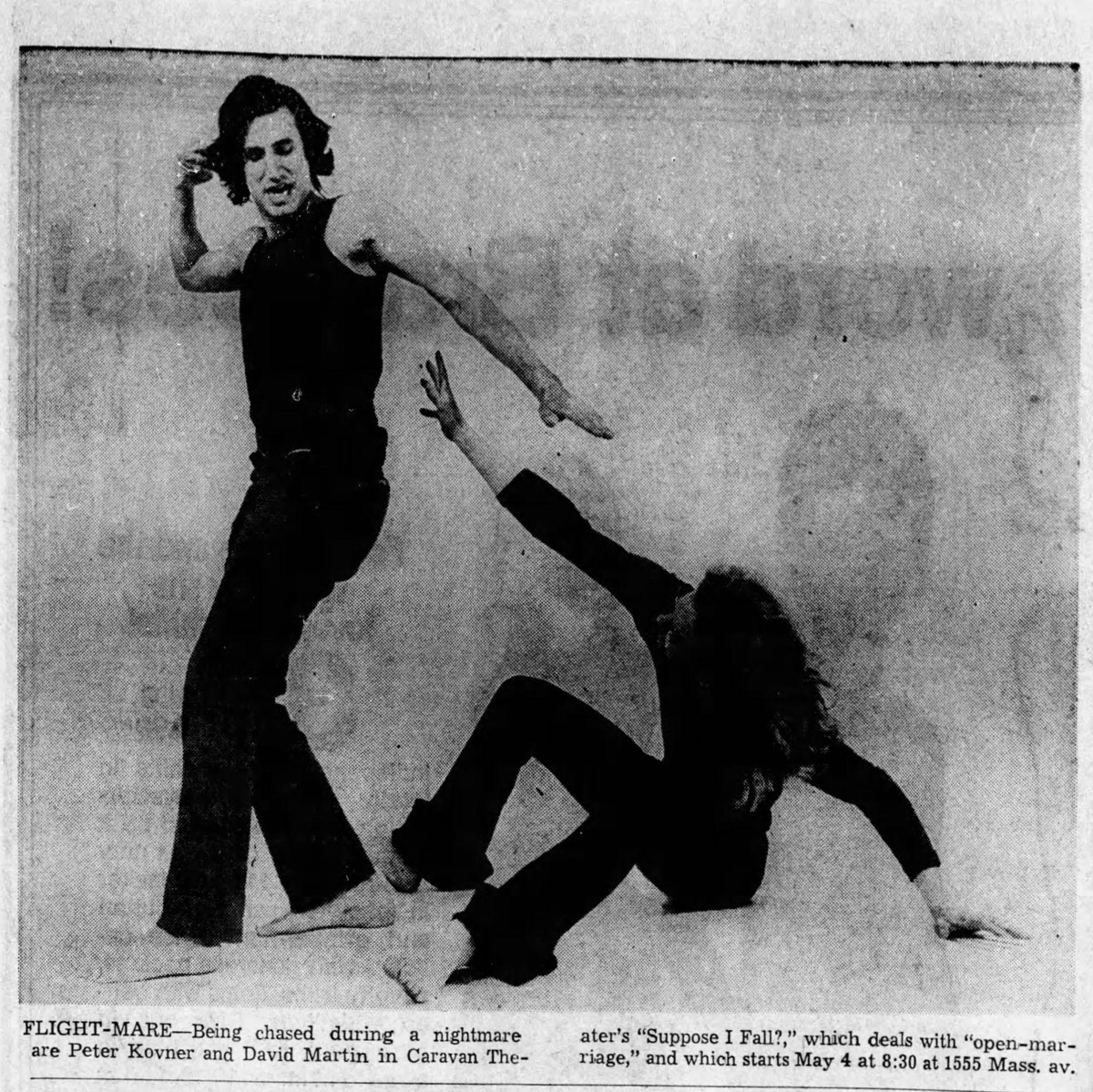
SUPPOSE I FALL by Stan Edelson & Ensemble
Directed by Stan Edelson
Original Cast: Pete Kovner, Nancy Lovell, David Martin, Julie Ince
May-June, 1973 & 1974
Revival Cast: Bob McCarthy, Joanne Ristau, John Watson, Cynthia Whitham
May 1973
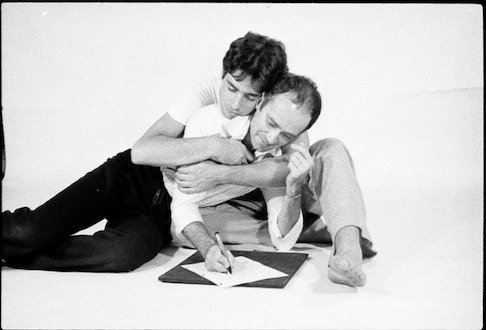
Two men and two women crisscross as different characters in multiple ‘dialogues’ exploring the social and sexual taboos of the era — both heterosexual and homosexual. The men, often struggling with their fear of weakness within relationships; the women, often with power. These spark conflicts and evasions, wish fulfillment (and wishes you wish hadn’t been fulfilled), humor and humanity; while at the last, offering direction and hope.”
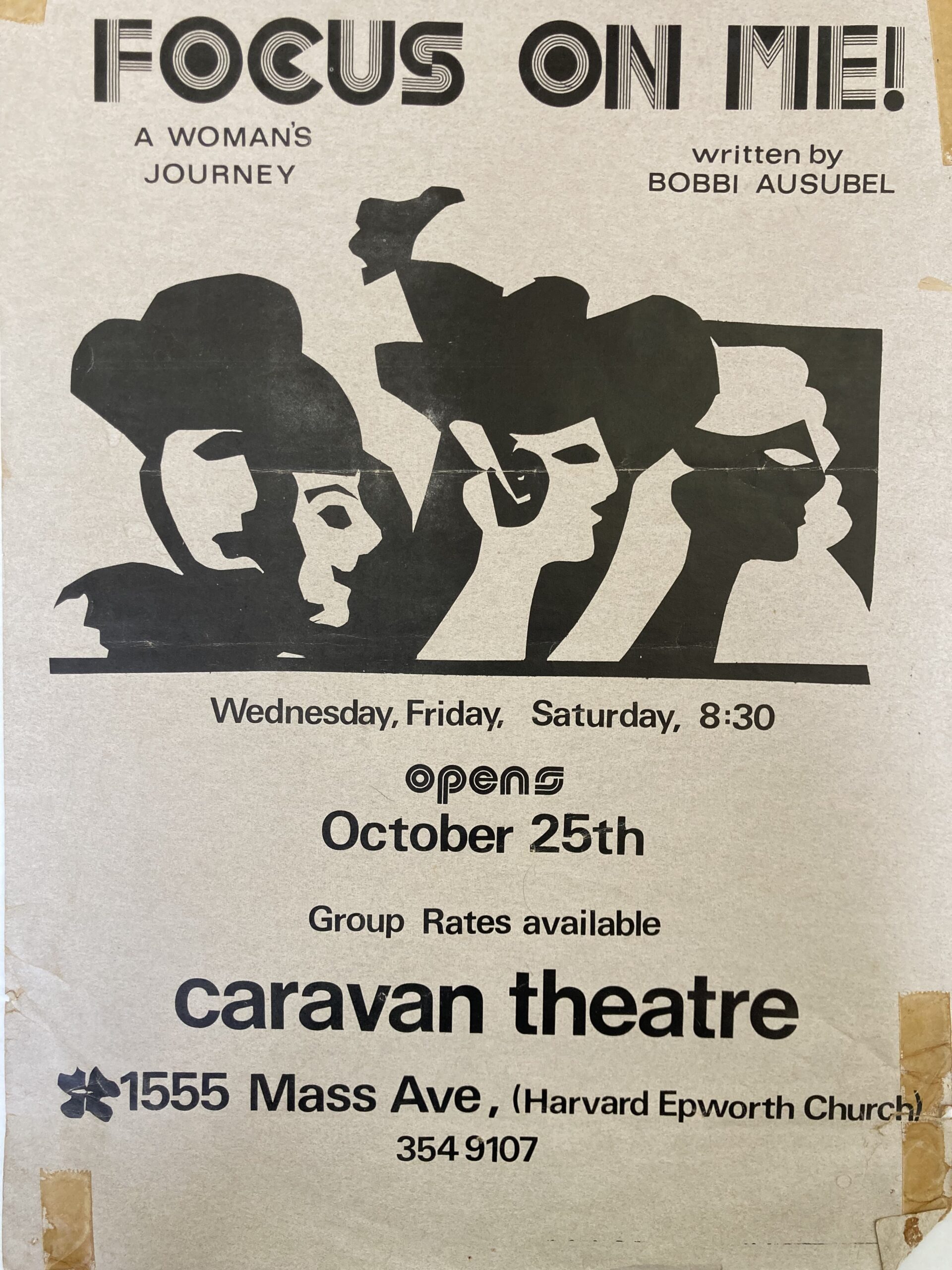
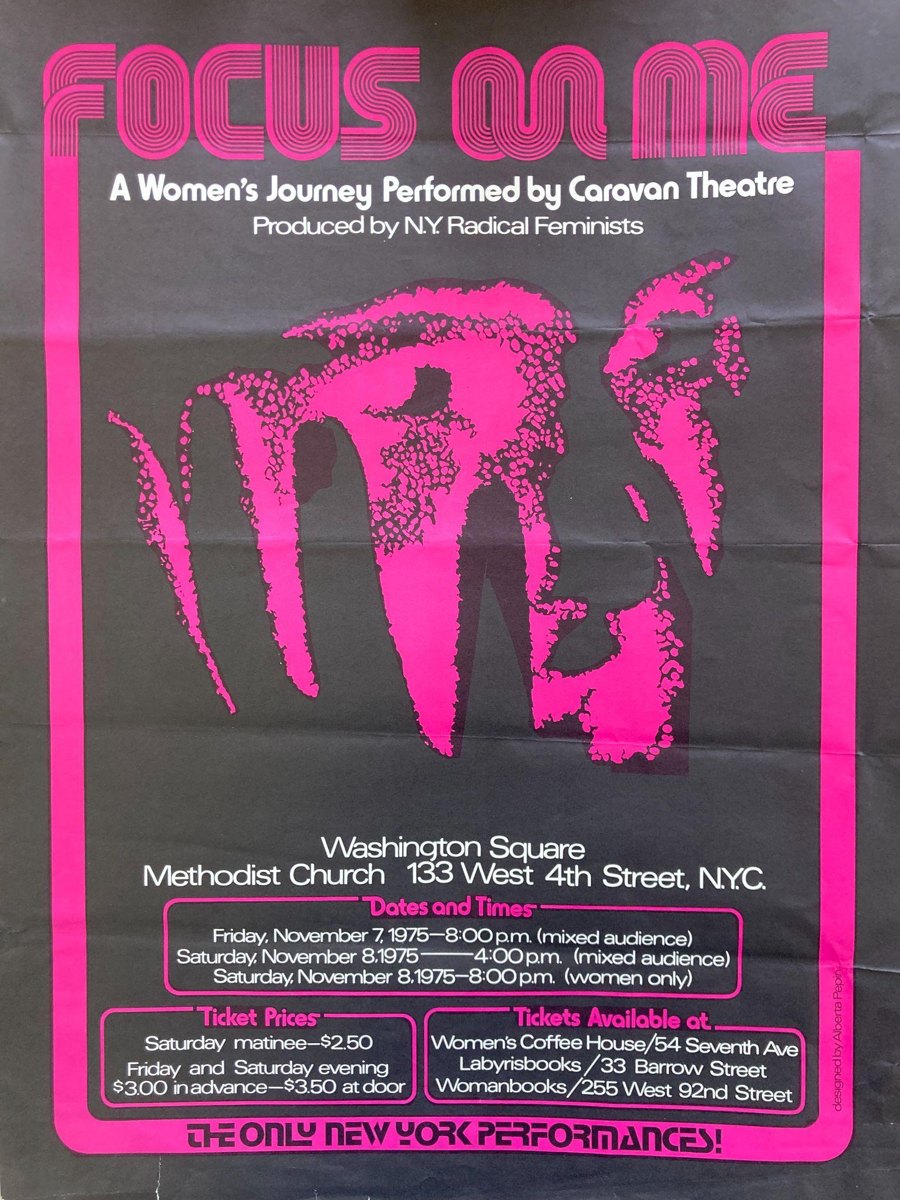
FOCUS ON ME by Bobbi Ausubel
Directed by Bobbi Ausubel
Original Cast: Joanne Ristau, Joan Trachtman, Cynthia Whitham. Kids: Alair MacLean & Beth Katz
March – June 1974
Revival Cast: Lin Kosy, Joan Trachtman, Joanna Temple, Sheila Green. Kids: Alair MacLean & Beth Katz
Nov 1974-Jan 1975
A female filmmaker explores her childhood, marriage, motherhood and work relationships in the process of accepting her femininity and vulnerability in a culture that highly values masculine traits.
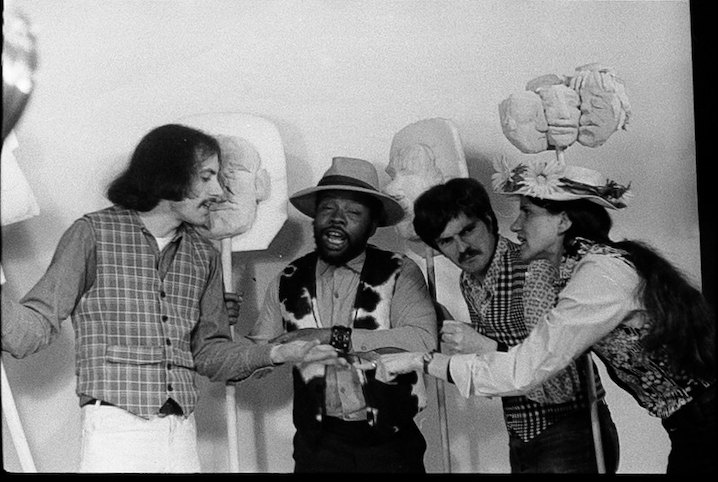
SAINT JOAN OF THE STOCKYARDS by Bertolt Brecht
Directed by Stan Edelson
Puppets: Lynn Bratley (Schiel)
YEAR: 1975
CAST: Klara Kalden, Raul Huerta, Deirdre Kelly, Mansur & 7 other actors
Joan is a member of the “Black Straw Hats” (a Salvation Army-like group) in 20th-century Chicago. Joan battles with Pierpont Mauler, the unctuous owner of a meat-packing plant. Joan is an innocent in a world of strike-breakers, fat cats, and penniless workers. Brecht’s play is laced with humor and songs and deals with the theme of emancipation from material suffering and exploitation. Masks, big ones, were used in the production.
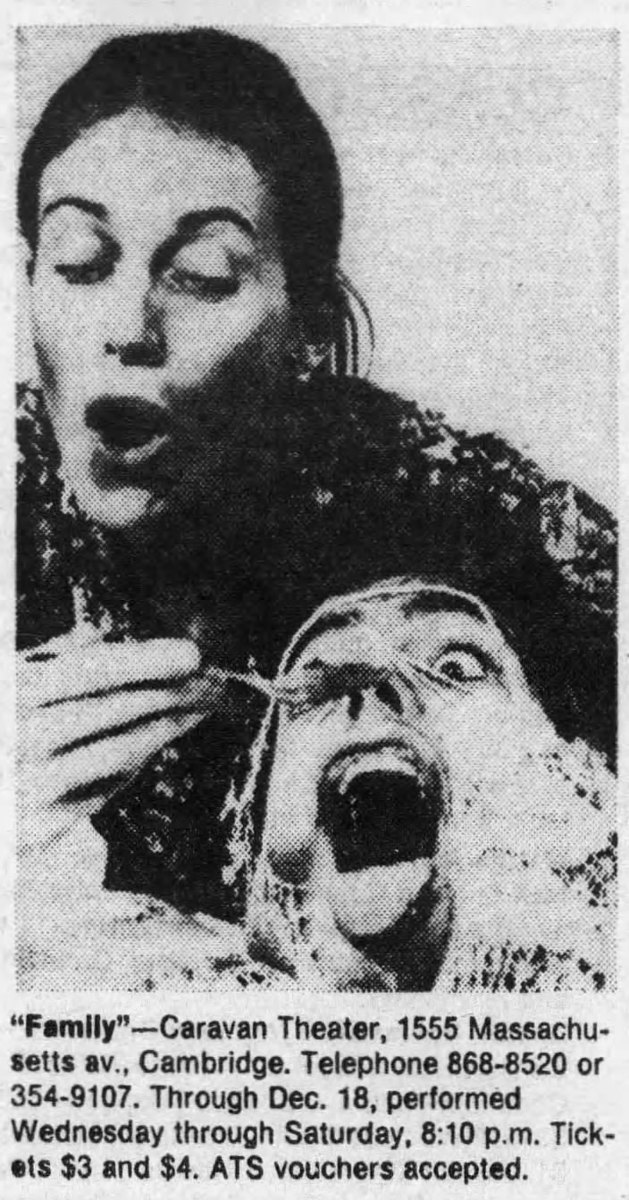
FAMILY a company-created play including works adapted from Agnes Smedley and Tillie Olson
Directed by Bobbi Ausubel and Stan Edelson
CAST: (Original): V. Olivia Casey, Mary Chalon, Jim Cooke, Linda Donald, Paul Fadoul, Michael Longo
CAST (Revival) V. Olivia Casey, Linda Grznar, Jim Cooke, Linda Donald, Paul Fadoul, Michael Longo
May 1976, and revived November 1976–1977
For this show, Caravan was voted “Best Ensemble” of the year in the Boston press. From a published review: “In a series of sketches the various aspects of family life in this society are examined, and mostly found wanting. The sketches are bright, clever and provocative. Most of the sketches were written or developed by the actors and are based on their personal experiences. In one piece, Edelson simply stands up and reads a letter from his mother, then comments briefly on it. It is artless, direct and effective.”
Additional description: One piece in this Family production is an adaptation of Tillie Olsen’s short story, I Stand Here Ironing. In it, a working-class single mother is ironing and thinking about her regrets, including how she must leave her daughter, who is not doing well, with another woman, so that she can worka job. Another piece in Family is a short excerpt from Agnus Smedley’s book Daughter of Earth. The piece, adapted by Bobbi Ausubel, shows a young working class woman’s journey to reach her mother before she dies.
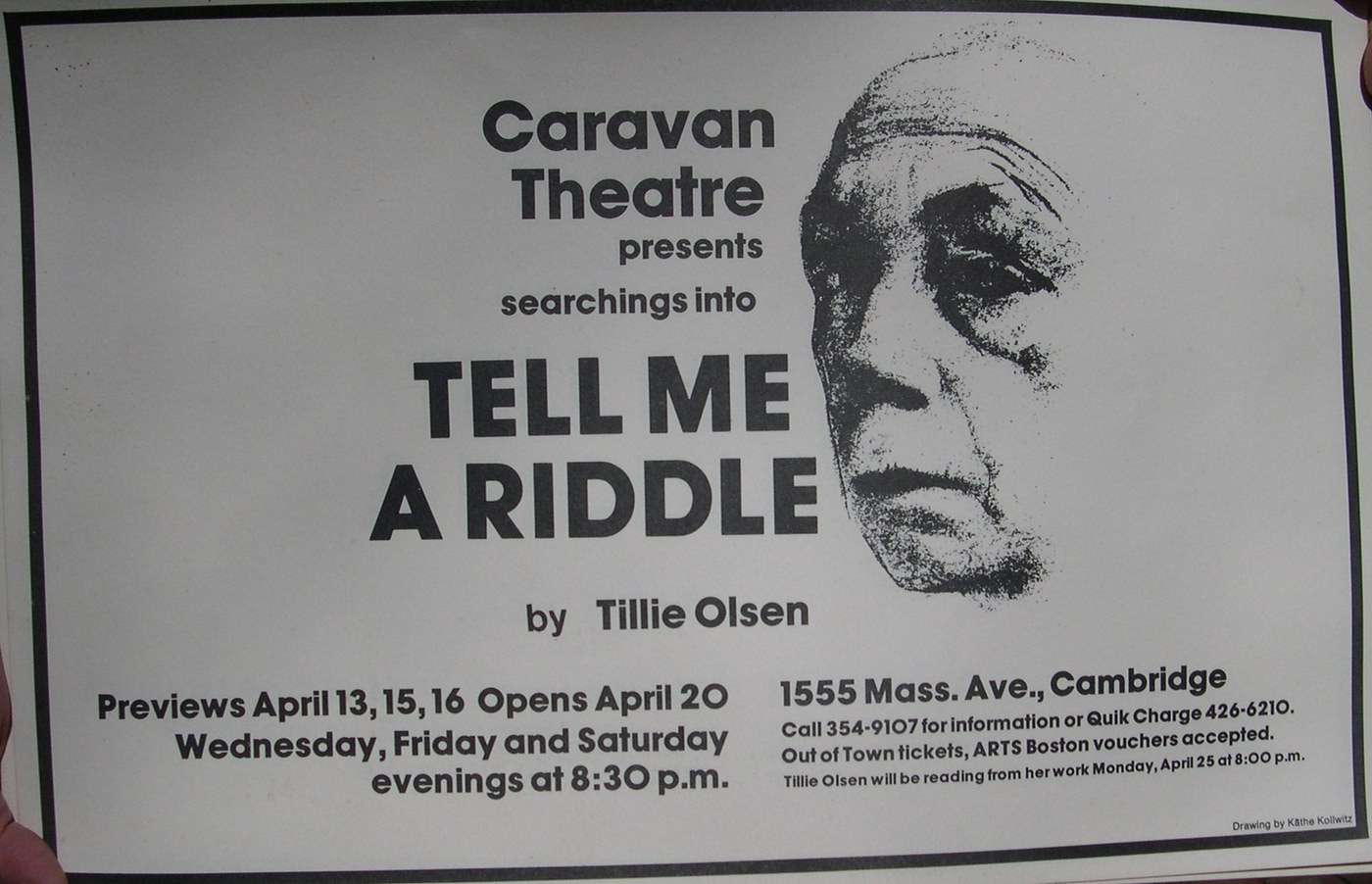
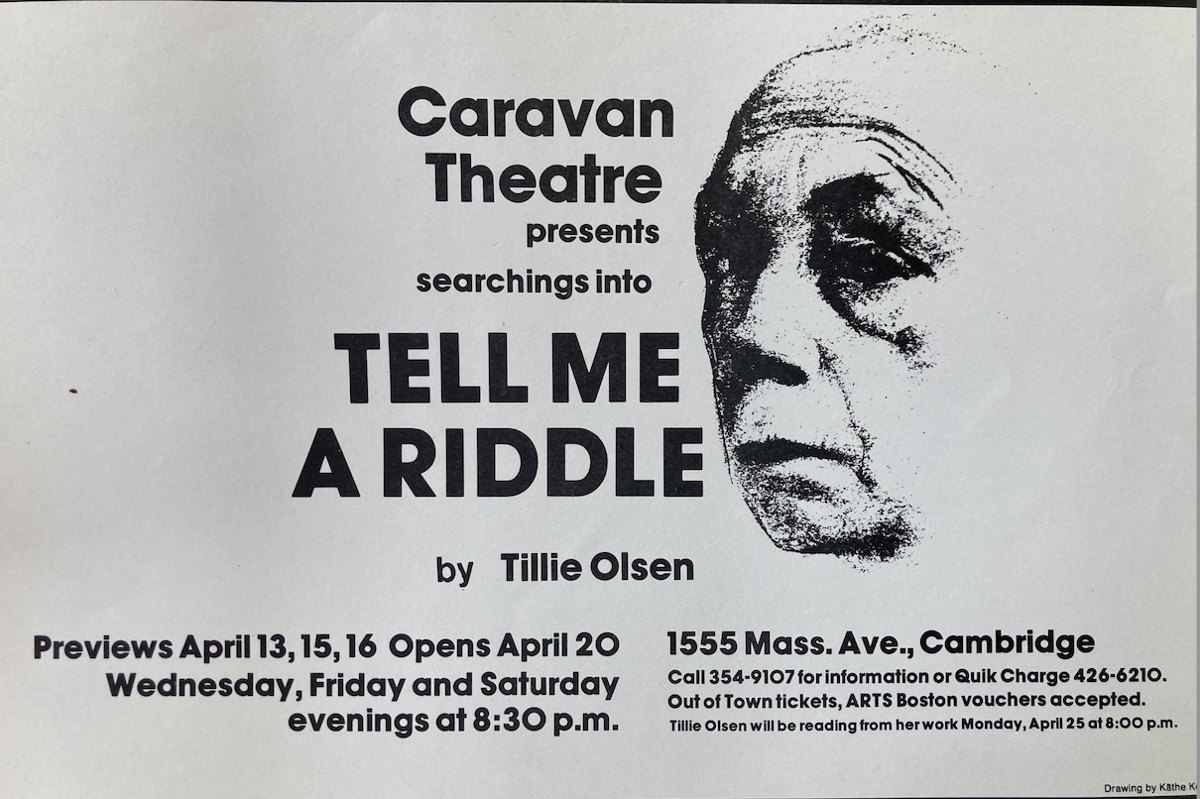
TELL ME A RIDDLE by Tillie Olson
Adapted and directed by Bobbi Ausubel
CAST: Linda Donald, V. Olivia Casey, Michael Longo, Mary Chalon, Paul Fadoul
Scenic Design & Lighting: Gail VanVoorhis
April-June 1976
The Boston Globe voted this play one of the “Ten Best Plays of the Year.” A working-class couple whose experiences of poverty, family life and gender cause deep relationship conflicts, even after four decades of marriage. As the wife, Eva, dies of cancer, surrounded by her caring family, she recalls her revolutionary past.
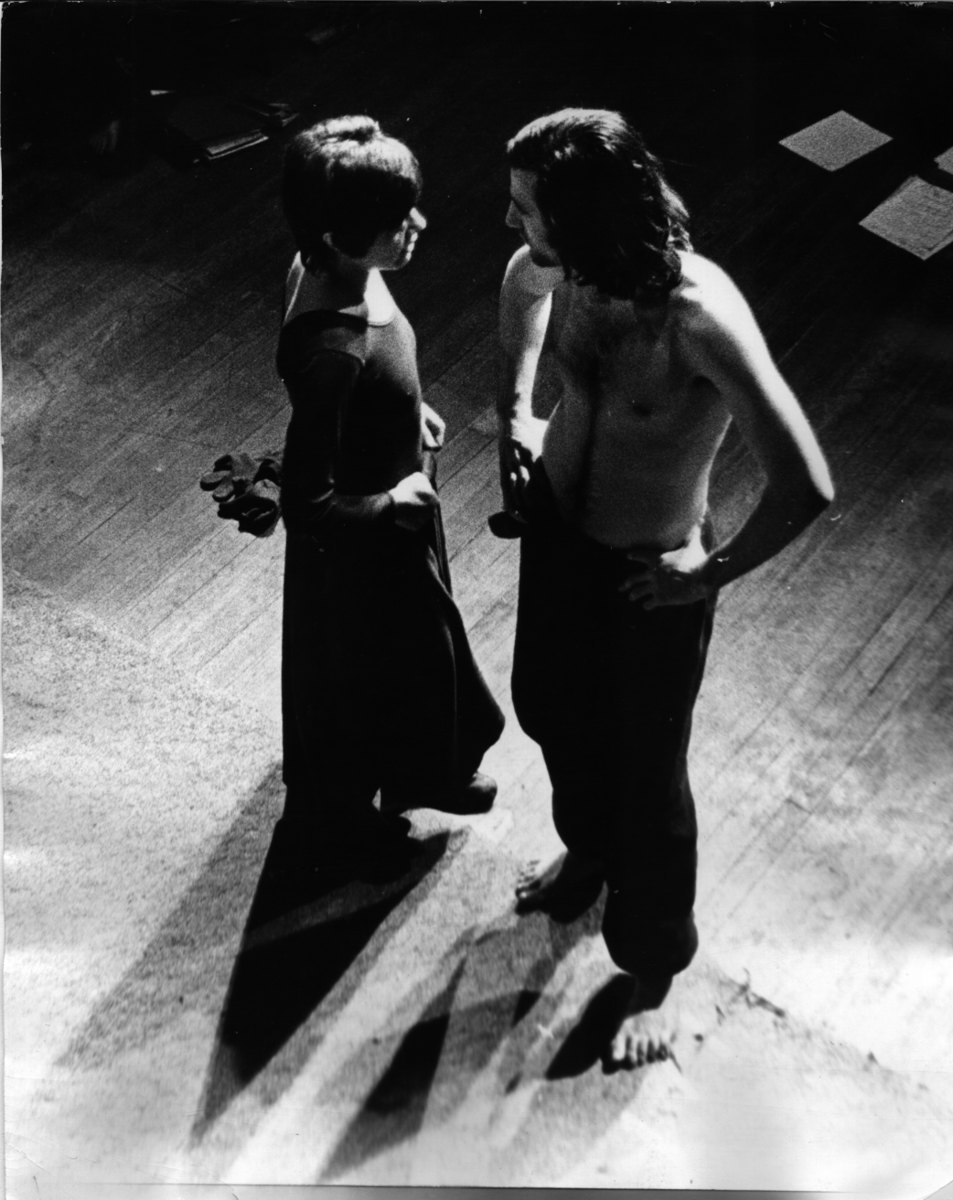
THE ASKING PRICE (originally titled PIMP) by Martha Boesing
Directed by Bobbi Ausubel
CAST: Olivia Casey, Mary Chalon, Naomi Thornton
October 1977
A vulnerable woman, shown with compassion, sells her daughter to give money to her new boyfriend.
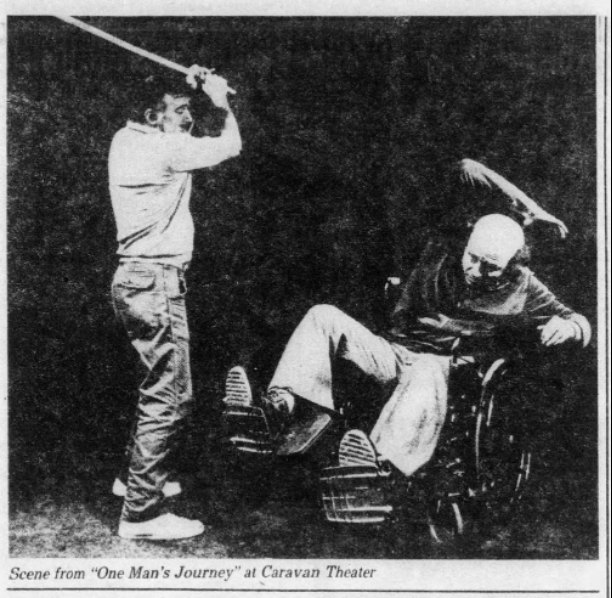
ONE MAN’S JOURNEY by Stan Edelson
Directed by Stan Edelson
CAST: Peter Kovner, Stan Edelson,
April 1978
A multi-media black comedy about a man facing a mid-life crisis after an automobile accident. Based on Stan’s own experience.
Children’s plays
HOW NANABOZHO BROUGHT FIRE TO HIS PEOPLE
a Native American legend adapted for the stage by Bobbi Ausubel
Directed by Bobbi Ausubel
Movement: Lynn Bratley (Schiel), Joe Volpe
December 1967 through February 1968
CAST: Lynn Bratley (Schiel), Joe Volpe, John Furlong, Bobbi Ausubel (Narrator)
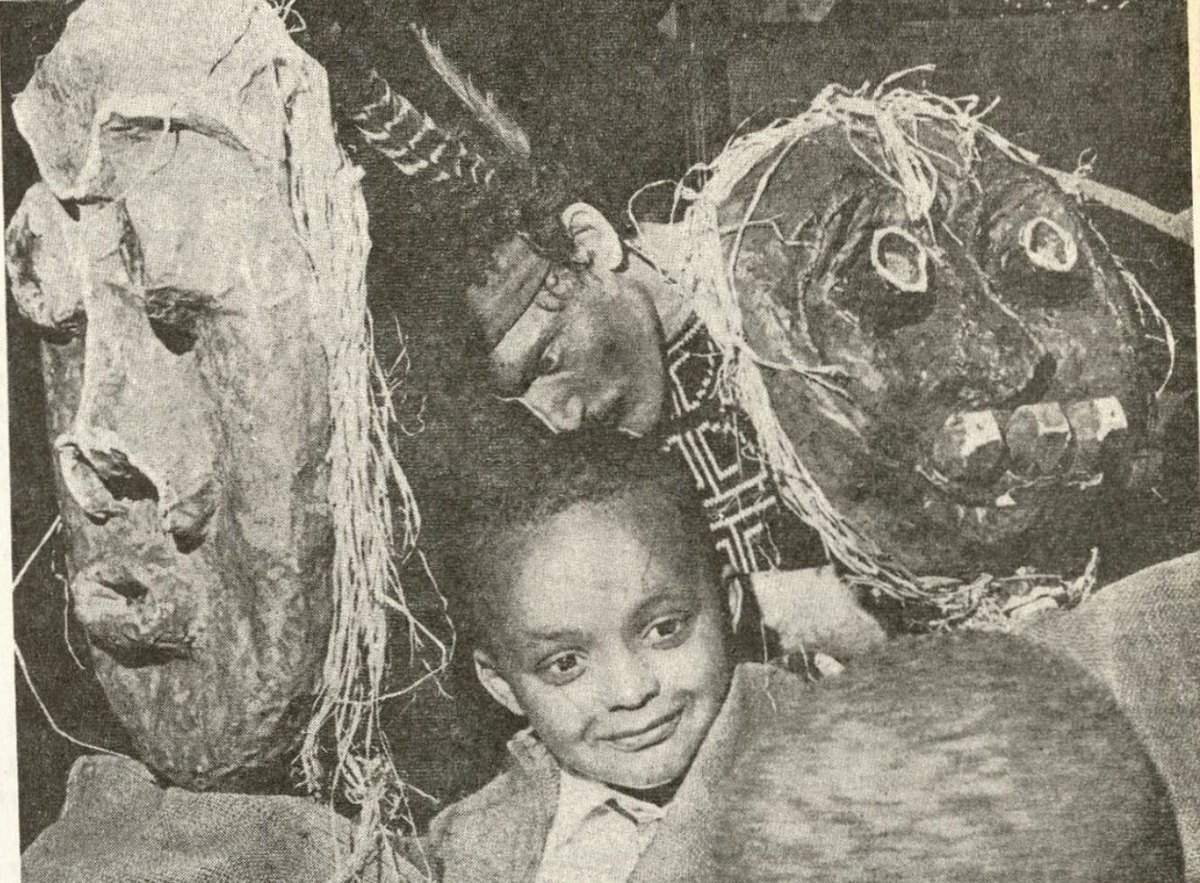
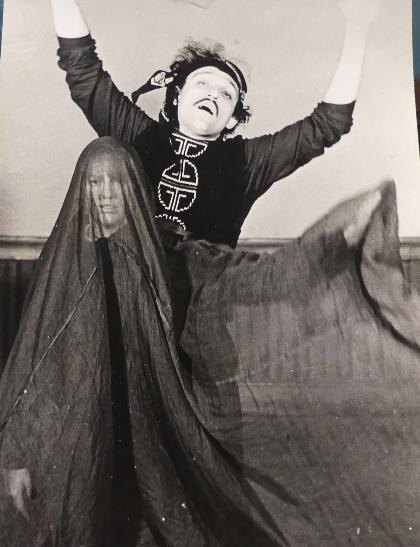
A children’s play with actors, puppets and audience participation. Depicted Nanabozho’s visit to Thunderbird to help bring fire to the people.
DON QUIXOTE IN THE CITY
adapted by Robert Bridges from Cervantes’s book
Directed by Robert Bridges
January 1970
CAST: Robert Bridges, David Baker Jr., Barbara “Buzz” Bregstein, Anne Barclay Priest
Children’s show based on the classic novel.
THE PARENT MARKET
June-July 1970
Children’s satire
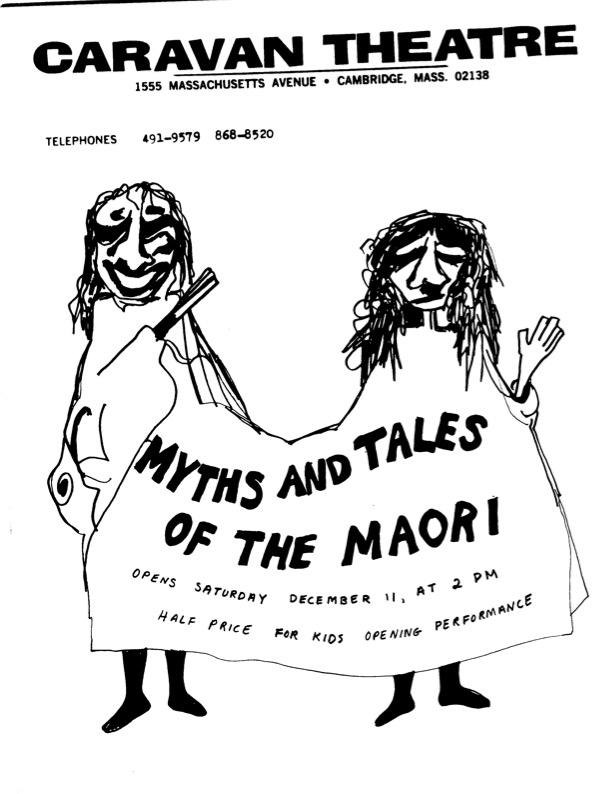
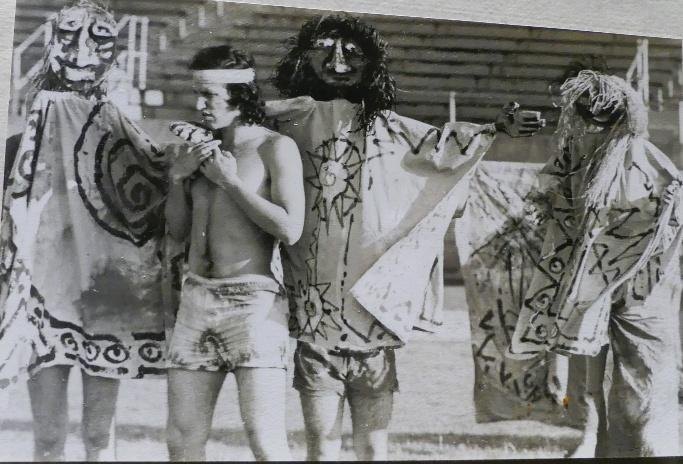
MYTHS & TALES OF THE MAORI
Developed & Directed by Ingrid Furlong, Lynn Bratley (Schiel) & Pauline Volpe
Puppets: Lynn Bratley (Schiel) & Eric Levinson
CAST: Jon Beam, Carole Gold, Buck Hobbs, Marianna Houston, Christopher Josephs, Pete Kovner, Sharon Landes, Eric Levenson, Amy Nathans, Lynn Bratley (Schiel)
December 1971 & Summer 1972
Tales are spoken, sung & danced
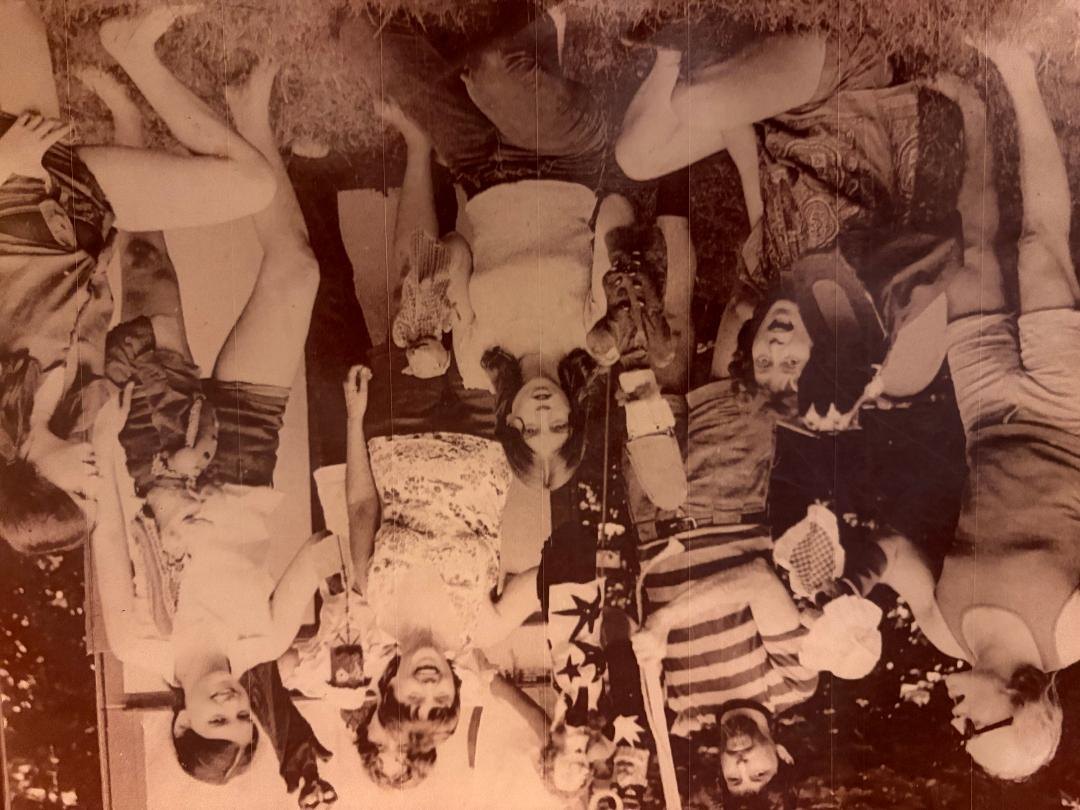
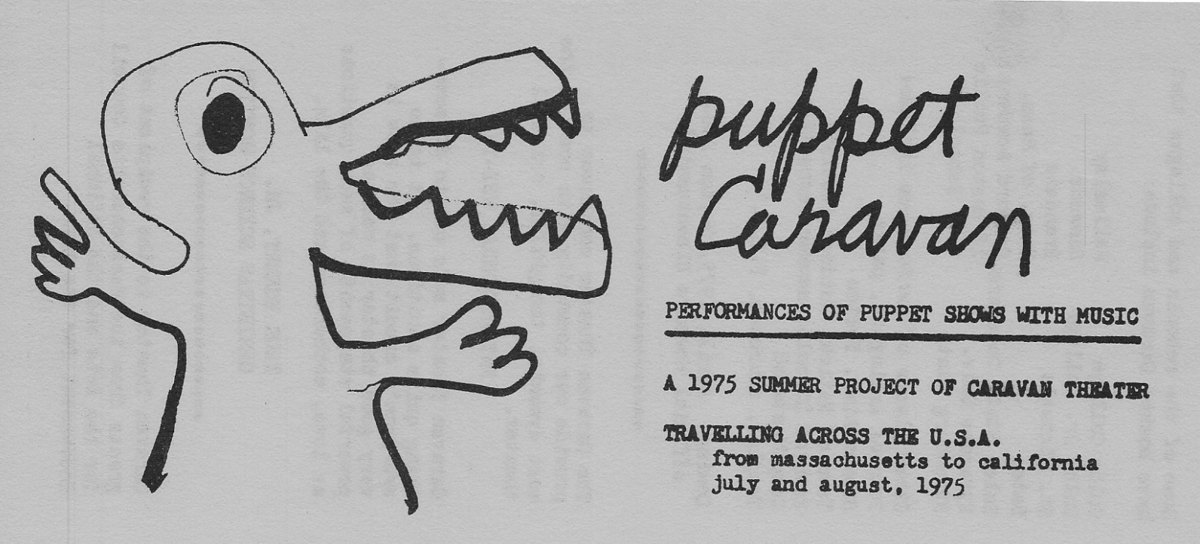
PUPPET CARAVAN by The Ausubel-Edelson Family
1972 Summer tour
Two families toured across the country, 4 adults, 4 children, in a van and put on shows in many venues.
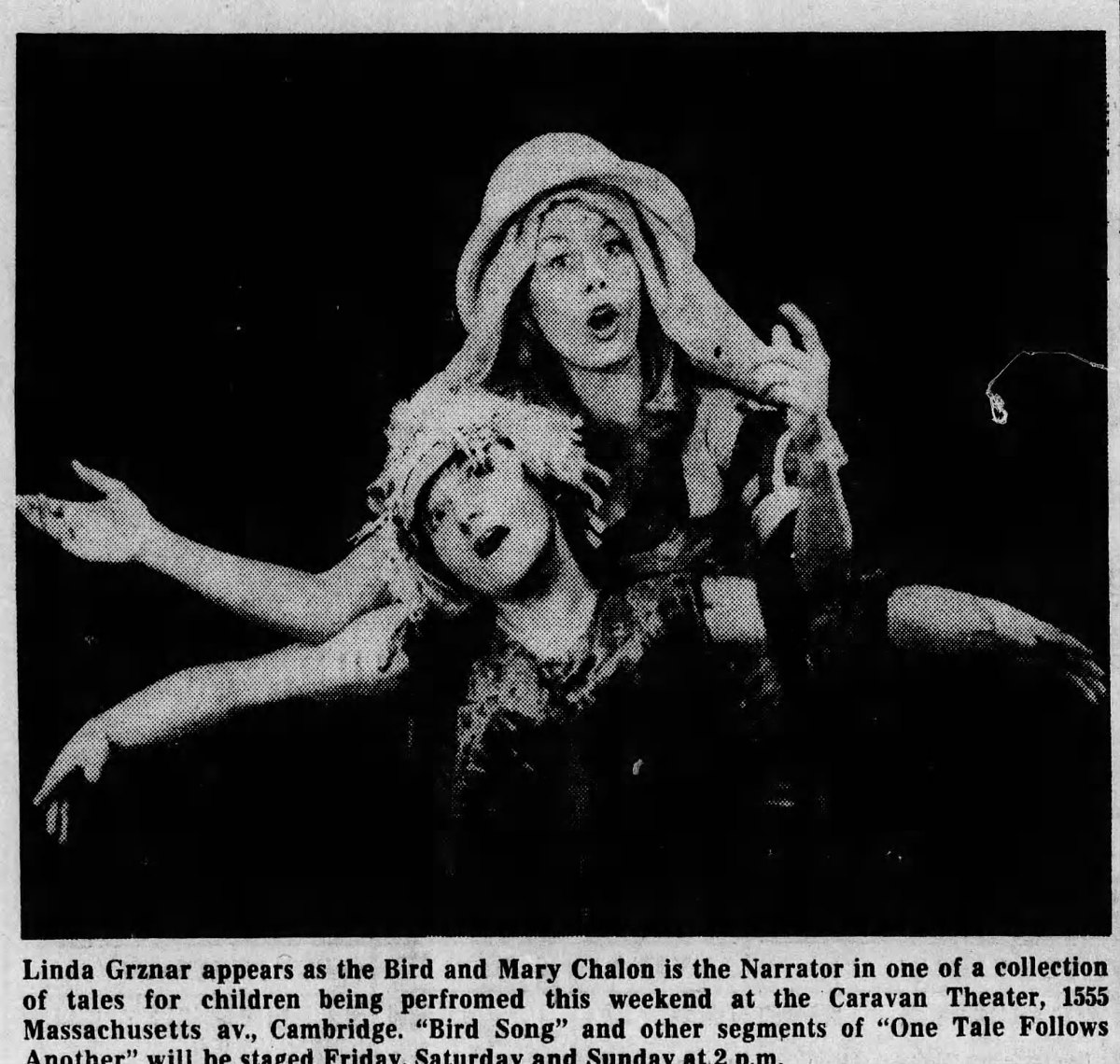
ONE TALE FOLLOWS ANOTHER
Directed by Bobbi Ausubel, Stan Edelson & Linda Grznar
CAST: Linda Grznar, Mary Chalon, V. Olivia Casey, Michael Longo, Ira Solet
December 1975– February 1976
Five short pieces – Collection of childhood dreams and fantasies for children 3 thru 12. Scenes are adaptations of short and created tales
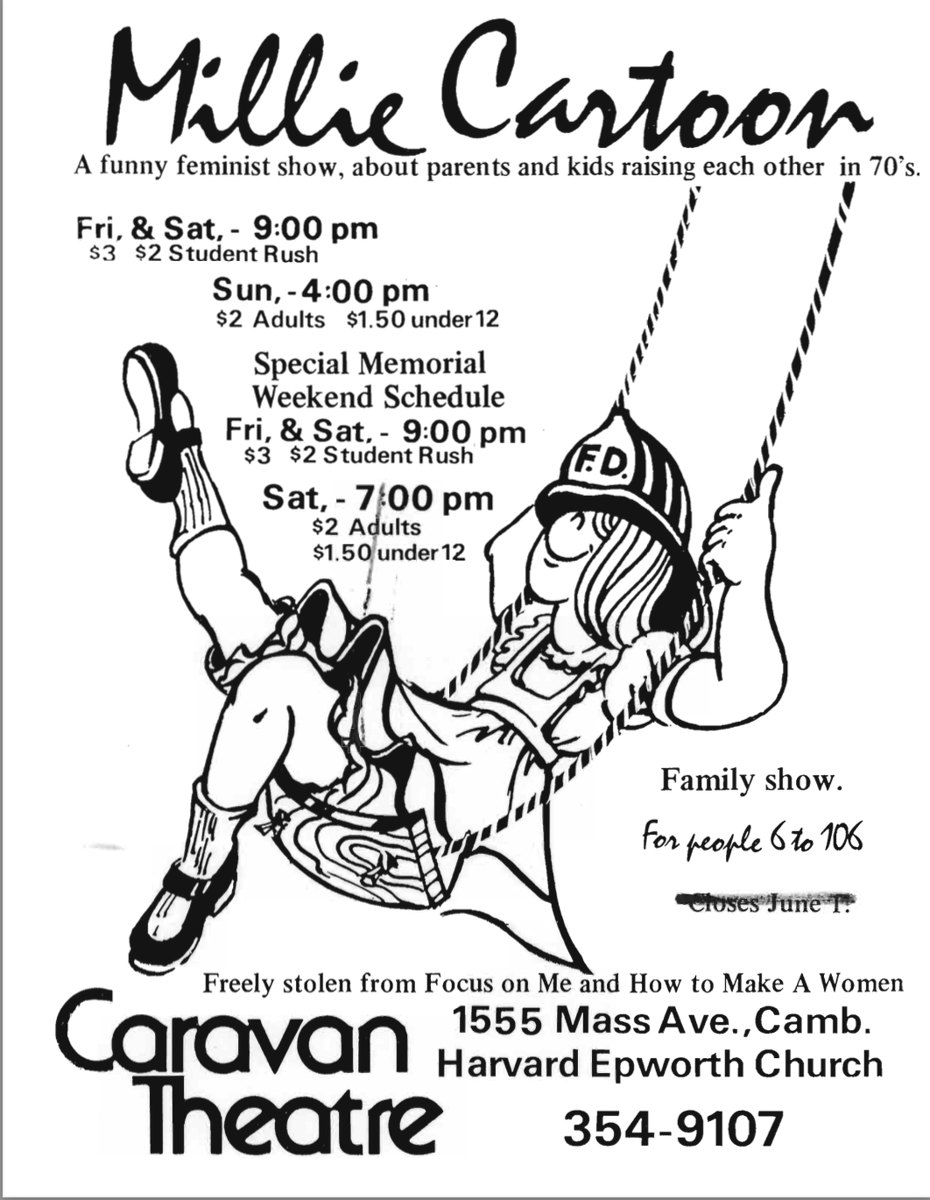
MILLIE CARTOON
compiled by Ingrid Furlong, Bobbi Ausubel, Stan Edelson
Directed by Ingrid Furlong and Bobbi Ausubel
CAST: Peter Kovner, Lynn Kosy, Lynn Bratley (Schiel), Joe Volpe, Pete Kovner, Mansur Raynor, Joanne Cazden, Barbara Greenberg
1976
Harvard Epworth Church and performances held at at Jordan Marsh, a popular Boston department store for Woman’s Bicentennial Celebration.
A feminist story told in bold movement, music and comedy by a child about her mother’s dreamy romance, marriage, joyful birth of the child, and subsequent overly devoted motherhood. The mother lives in her big white carton box, decked with colorful helium balloons. The mother subsequently finds her true self and smashes the balloons, enacting her freedom.
“The Maids” — near genius. “Iphigenia in Aulis” — near brilliant.The Boston Globe
Press & reviews
Caravan was covered widely across its run — from raves to red-baiting. A selection of what the papers said:
- The Boston Globe ran a ten-page Sunday Magazine profile of the company (1970) and called The Maids “near genius” and Iphigenia in Aulis “near brilliant.”
- Boston Phoenix — Laura Shapiro on How to Make a Woman (1970): the play’s power “never [fell] into polemics… the truths that [came] tumbling out [were] piercingly immediate.”
- The Boston Herald and Patriot Ledger on Caucasian Chalk Circle (1969–70) — “innovative and rousing.”
- The New York Times covered How to Make a Woman at the Wrocław Festival of Festivals in Poland (1971).
- The Harvard Crimson reviewed How to Make a Woman and Waiting for Godot, among others.
- The Boston Globe named Tell Me a Riddle one of the Ten Best Plays of the Year (1977).
Reviews of Plays From the Press
- Feb. 7, 1968Caravan Theater makes Brecht goThe Boston Globe · David NobleView scan
- May 6, 1968‘Maids’ is near geniusThe Boston Globe · Kevin KellyView scan
- Oct. 25, 1968Brecht’s 1938 ‘Measures’ still timelyThe Boston Globe · Kevin KellyView scan
- Dec. 13, 1968Greek tragedy anti heroic and grimly funnyThe Boston Globe · Kevin KellyView scan
- Dec. 26, 1968Greek Drama In Modern Garb: Caravan Euripides As Anti-Viet StatementThe Jewish Advocate · Ruth WarnerView PDF
- Oct. 1, 1969Caravan reexamines feminismBoston After Dark · Jerry Spindel · 2 pagesView PDF
- Oct. 1, 1969How To Make A WomanReviews compiled by Aili Paal Singer · 5 pagesView PDF
- Oct. 2, 1969The Theatregoer: How To Make A WomanThe Harvard Crimson · Jill Curtis · 6 pagesView PDF
- Dec. 24, 1969Brilliant Brechtian ConceptionThe Patriot Ledger · Carl DeVatoView PDF
- Jan. 11, 1970Boston’s off-BroadwaySunday Herald Traveler · Donald Cragin · 4 pagesView PDF
- Jan. 21, 1970The Theatregoer: The Caucasian Chalk CircleThe Harvard Crimson · Jeffrey S. Golden · 8 pagesView PDF
- March 1970Caravan Theatre: The Caucasian Chalk Circle and How to Make a WomanBoston After DarkView PDF
- May 16, 1970Topic: WomenThe Washington Post · Judith MartinView PDF
- Oct. 30, 1970How to Make a Woman at the Harvard Epworth Church every Fri. and Sat.The Harvard Crimson · Carol R. Sternhell · 7 pagesView PDF
- Nov. 12, 1970Advocating TheatreThe Jewish Advocate · Larry BlumsackView PDF
- April 20, 1972‘Hands Off!’: The Touch That PleasesThe Harvard Independent · Joe Gallagher · 2 pagesView PDF
- April 21, 1972Keep ‘Hands-Off’ in MindThe Educator · Jane Harris · 3 pagesView PDF
- Spring 1972Come Closer, You’re Smothering MeBoston After Dark · Carolyn ClayView PDF
- Nov. 28, 1972Caravan Theater’s ‘Godot’ takes it’s time, but gets thereThe Boston Globe · William A. Henry 3dView scan
- Dec. 1, 1972Mating Them Up For GodotThe Harvard Crimson · Phil Patton · 7 pagesView PDF
- Dec. 19, 1972Waiting for GodotBoston Phoenix / Boston After Dark · Carolyn Clay · 2 pagesView PDF
- June 1973Brecht’s ‘Exception’: Passing WaterBoston After Dark / Boston Review of the Arts · Alan Levitan · 2 pagesView PDF
- Jan. 8, 1974‘Suppose I Fall’ reopened with new cast, new sketchesThe Boston Globe · Carolyn ClayView scan
- Nov. 4, 1974Out of FocusThe Harvard Crimson · Barbara Fried · 9 pagesView PDF
- Feb. 19, 1975Caravan Brecht funny and topicalThe Boston Globe · Patrick McGilliganView scan
- May 12, 1975Caravan in winning retreatThe Boston Globe · William A. Henry 3dView scan
- May 30, 1975Caravan Theater’s ‘Millie Cartoon’The Boston Globe · Otile McManusView scan
- Feb. 20, 1976Children’s theater with verveThe Boston Globe · Robert TaylorView scan
- May 25, 1976‘Family’ as theater and therapyBoston Evening Globe · Ray MurphyView scan
- Nov. 5, 1976‘Family’ drives point homeThe Boston Globe · Kevin KellyView scan
- May 20, 1977‘Riddle’ makes an eloquent statementThe Boston Globe · Kevin KellyView scan
- Dec. 10, 1977‘Price’ not worth itThe Boston Globe · Kevin KellyView scan
- Nov. 24, 1978‘Focus’ homes in on the tough and soft in us allChicago Tribune · Linda WinerView PDF
Other Media Articles
- May 21, 1966The Tolerant View Of the Avant GardeThe Boston GlobeView PDF
- April 9, 1968Young couple and their theaterThe Boston Globe · Kevin KellyView scan
- April 13, 1969Youngsters Enliven Plays In Cambridge ProjectThe Boston Globe · Phyllis CoonsView scan
- Aug. 10, 1969Local Theater Seeks to Free Abused FemaleThe Boston Globe · Ann BlackmanView scan
- Feb. 5, 1970Caravan Theatre Varied OfferingsThe Jewish AdvocateView PDF
- April 5, 1970The Theater Company: acts of faithThe Boston Globe · 3 pagesView PDF
- April 24, 1970Caravan Theater plans workshopThe Boston Globe · Melvin JohnsonView scan
- Oct. 22, 1970A reader asks about the Caravan Street TheaterThe Boston GlobeView PDF
- Nov. 29, 1970The Caravan: ‘You can be in theater and politics at the same time’Boston Sunday Globe Magazine · Deckle McLean · 11 pagesView PDF
- March 26, 1971Jason-Medea: audience members trade valuables for ticketsThe Boston GlobeView PDF
- Nov. 21, 1971Only the Playwright Was AbsentThe New York Times · Charles Marowitz · 2 pagesView PDF
- Dec. 12, 1971Caravan’s liberated woman finds Polish girls ‘emancipated’The Boston Globe · Bobbi AusubelView scan
- 1972 · Vol. 1, No. 4‘Liberated’ American Woman Meets ‘Emancipated’ Polish WomanThe Second Wave · 6 pagesView PDF
- Feb. 20, 1972Advertisement: ‘The Exception and the Rule’The Boston GlobeView PDF
- March 12, 1972The Men’s Liberation movementBoston Sunday Globe · Ellen GoodmanView scan
- April 14, 1972‘Hands-Off’ gripping dramaThe Boston Globe · Melvin JohnsonView scan
- April 23, 1972Radcliffe’s ‘Summit’: Too Many GapsThe Washington Post · Myra MacPherson · 2 pagesView PDF
- Nov. 10, 1974Boston’s off-Broadway scene: Small theaters and big talentsBoston Sunday GlobeView scan
- Nov. 5, 1976Critic’s pick: ‘Family’The Boston Globe · Kevin KellyView PDF
- Dec. 3, 1986Caravan Theater undergoes a rebirthThe Boston Globe · John EngstromView scan
- April 1, 2001Vignettes, cast share theme of diversityBoston Sunday Globe · David WildmanView scan